It is the most frustrating scenario in field maintenance: the cooling unit is powered, the fans are spinning, and the compressor vibration indicates it is active, yet the internal temperature sensor is climbing into the danger zone. When a micro ac runs but cabinet still hot, the issue is rarely a catastrophic component failure. More often, it is a subtle integration misalignment between the cooling system’s physics and the enclosure’s reality.
For OEM engineers and system integrators deploying into harsh, off-grid, or mobile environments, “uptime” is often synonymous with “thermal stability.” Whether it is a telecom repeater in the Mojave or a battery storage unit on an offshore platform, the physics of heat rejection remain unforgiving. When the active cooling loop fails to depress the internal temperature, the root cause typically lies in airflow management, environmental loading, or power delivery constraints rather than the refrigerant cycle itself.
This article takes a forensic approach to diagnosing these “phantom failures.” We will bypass the marketing fluff to look at the thermodynamics of sealed enclosures, identifying why a mechanically sound system might fail to protect critical electronics and how to engineer a resilient solution.
The Deployment Context: Where Thermodynamics Meets Reality
To understand why cooling fails, we must first establish the constraints of the environment. In B2B engineering, we rarely deal with laboratory conditions. We deal with mud, salt, vibration, and fluctuating DC buses.
Scenario A: The Remote Telecom Node
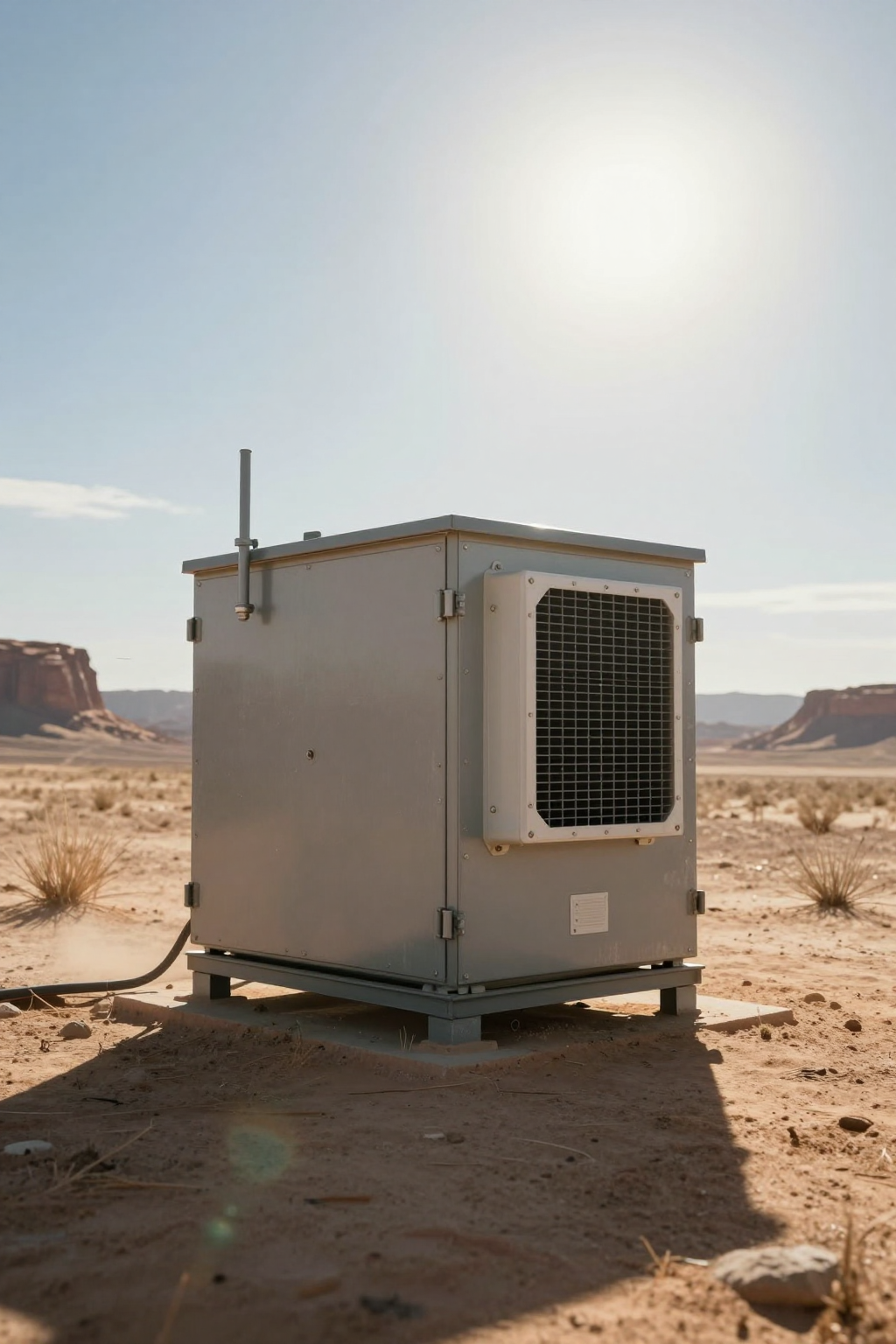
Consider a roadside cabinet housing 48V rectifiers and lithium backup batteries. The ambient temperature peaks at 45°C (113°F). The enclosure is exposed to direct solar loading for six hours a day. The site is unmanned, meaning a “high temp” alarm triggers a truck roll costing hundreds of dollars. Here, the cooling system must not only handle the internal heat load (approx. 300W) but also the massive solar gain, all while running off a DC battery bank where efficiency is paramount.
Scenario B: The Mobile Industrial Controller
Alternatively, consider a control panel mounted on a heavy-duty mining vehicle. The vibration is constant. Dust ingress is a primary threat, requiring a NEMA 4 or IP65-level seal. The power source is the vehicle’s 24V alternator system, which is noisy and prone to voltage sags. In this context, a micro ac runs but cabinet still hot scenario often points to power starvation or airflow blockage caused by internal component density.
Decision Matrix: Selecting the Right Thermal Strategy
Before diagnosing a fault, one must verify that the chosen technology is capable of the task. A common error is expecting a passive system to perform active cooling duties. The table below compares the three dominant strategies for sealed enclosures.
| Feature | Filter Fans (Open Loop) | Thermoelectric (TEC/Peltier) | Micro DC Aircon (Compressor) |
|---|---|---|---|
| Sub-Ambient Cooling | Impossible (Always T_internal > T_ambient) | Yes (Limited capacity) | Yes (High capacity) |
| Sealed Enclosure (IP/NEMA) | No (Requires air exchange) | Yes (Closed loop) | Yes (Closed loop) |
| Dust/Humidity Tolerance | Low (Filters clog, moisture enters) | High (No ingress) | High (No ingress + dehumidification) |
| Power Efficiency (COP) | High (Fans only) | Low (Typically 0.5 – 0.8) | High (Typically 2.5 – 3.5) |
| Typical Heat Load Range | Low to High (Depends on Delta T) | Low (< 200W usually) | Medium to High (100W – 3000W+) |
| Best-Fit Scenario | Indoor, clean, T_amb < T_target | Small enclosures, low heat, precise control | Outdoor, harsh, high heat, T_amb > T_target |
Implication: If your ambient air is hotter than your target internal temperature, fans are unlikely to meet the requirement of cooling. If your heat load exceeds 200-300W, TECs often consume more power than the equipment they cool. For most outdoor or high-load sealed applications, vapor compression (Micro DC Aircon) is the standard for a reason.
Quick Selection Rules for the Design Review
- Rule 1: If T_ambient ≥ T_target, you must use active cooling (Compressor or TEC). Fans are often insufficient.
- Rule 2: If the enclosure requires IP65/NEMA 4 sealing (washdown, salt spray, conductive dust), you cannot use open-loop fans.
- Rule 3: If the heat load is >300W and power is limited (battery/solar), a DC compressor is typically the only viable option due to COP advantages over TECs.
- Rule 4: If the power source is 12V/24V/48V DC, avoid AC inverters. Use native DC cooling to eliminate conversion losses (10-15%).
- Rule 5: If solar loading is present, add 20-30% to your calculated internal heat load margin.
The Forensic Path: 5 Reasons It Runs But Stays Hot
Assuming you have selected the correct technology—likely a Micro DC Aircon or similar vapor compression system—why does the cabinet remain hot? Here are the five most common integration faults we see in the field.
1. The Thermal Short Circuit (Bypass Airflow)
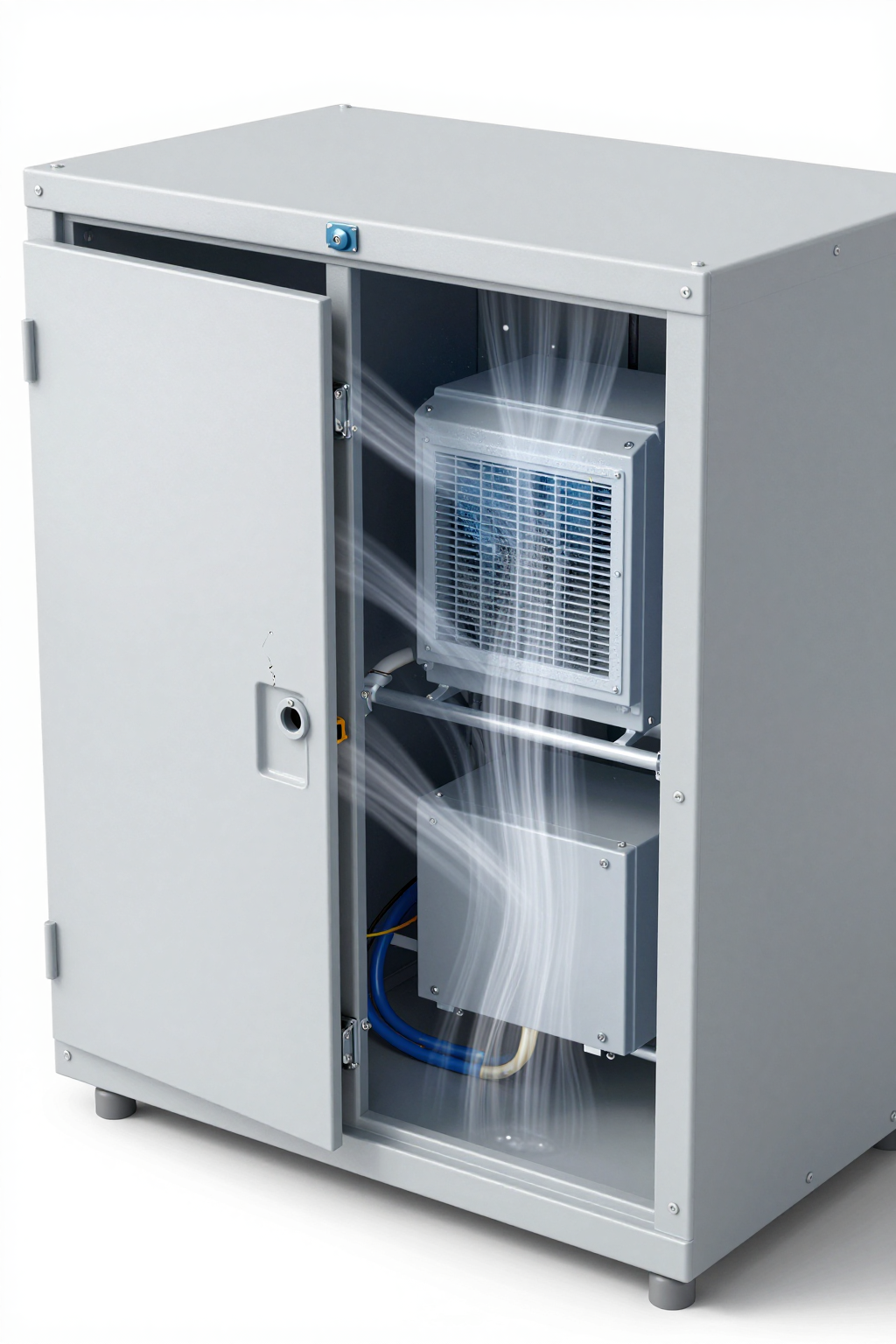
This is the single most common cause of the “running but hot” phenomenon. In a tightly packed cabinet, if the cold air discharge from the cooling unit is obstructed or directed straight back into its own return intake, the unit “thinks” its job is done.
Mechanism: The cold air exits the unit, hits a cable bundle or a shelf, and deflects immediately into the return vent. The thermostat (often located at the return air intake) reads the cold supply air, assumes the cabinet is 20°C, and throttles down the inverter compressor or cycles it off. Meanwhile, the components at the top or bottom of the rack are baking at 60°C.
2. The Solar Trap (Undersized for Radiation)
Engineers often calculate heat load based solely on the power dissipation of the internal electronics (e.g., 400W of equipment). They select a 450W cooler. In a lab, this works perfectly. Outdoors, it fails.
Mechanism: Solar radiation can add roughly 1000W per square meter of exposed surface area. Even with insulation, a significant thermal load bleeds through the cabinet walls. If this external load is not accounted for, the cooling unit spends all its capacity fighting the sun, leaving zero headroom for the internal electronics. The unit runs at 100% duty cycle, but the temperature never drops.
3. The “Leaky Bucket” (Sealing Integrity)
Active cooling relies on a closed loop. If the enclosure is not sealed, the unit is trying to cool the entire outside world.
Mechanism: Poorly sealed cable glands or missing gaskets allow hot, humid ambient air to be sucked into the cabinet. This introduces a massive latent heat load (moisture). The air conditioner spends its energy condensing water out of the air rather than lowering the sensible temperature. You will see water dripping, but the air temperature won’t drop. Closed-loop designs avoid air exchange, but overall ingress protection still depends on gasket integrity, cable glands, and installation quality.
4. Power Starvation (Voltage Drop)
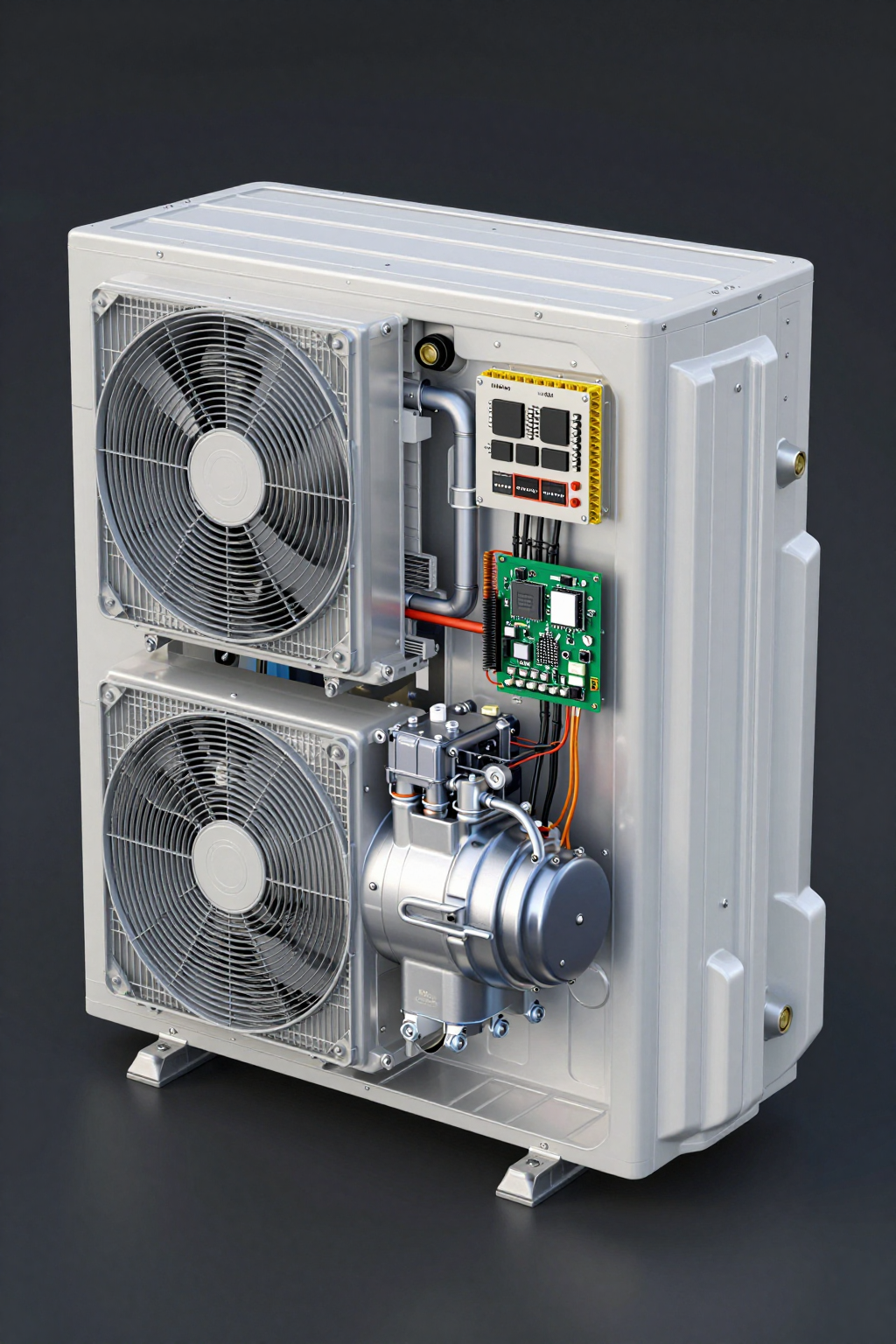
In 12V or 24V systems, cable sizing is critical. A unit might be rated for 24V, but if long, thin cables cause a voltage drop to 21V under load, performance suffers.
Mechanism: When the compressor attempts to ramp up to high speed (high load), the current draw increases. If the resistance in the supply wire is too high, voltage at the terminals drops. Many modern BLDC drivers have under-voltage protection or fold-back logic. They will reduce the compressor speed to prevent a system crash. The unit continues to “run,” but at minimum capacity (e.g., 100W cooling instead of 450W), resulting in a hot cabinet.
5. Sensor Blindness
Where is the temperature being measured? If the cabinet’s main controller uses a sensor placed directly in the path of the AC’s cold air stream, it will report a false “OK” status.
Mechanism: The AC unit is doing its job, but the system integrator has placed the monitoring probe in a cold pocket. The HMI says 25°C, but the VFDs at the top of the cabinet are tripping on over-temp faults. This is a failure of thermal mapping, not cooling capacity.
Engineering Fundamentals: Why Physics Wins
To prevent these issues, it helps to understand the “Why” behind the hardware. A Micro DC Aircon is not a magic box that destroys heat; it is a heat pump. It moves thermal energy from the evaporator (inside) to the condenser (outside).
The Delta T Constraint: The rate of heat transfer is proportional to the temperature difference (Delta T) between the refrigerant and the air. If the condenser is clogged with dust (common in mining/agriculture), it cannot reject heat to the ambient air efficiently. The compressor discharge pressure rises, and the system efficiency (COP) plummets. Eventually, the safety logic limits the compressor speed to protect the hardware, reducing cooling capacity exactly when you need it most.
Sensible vs. Latent Heat: Cooling capacity is split between lowering temperature (sensible) and removing moisture (latent). In a perfectly sealed cabinet, moisture removal is a one-time event. In a leaky cabinet, moisture removal is continuous. Since phase change (condensing water) requires massive energy, a leaky cabinet forces the AC to act as a dehumidifier, leaving little power left to actually cool the equipment.
Performance Data: Verified Specifications
When selecting a unit to combat these issues, relying on verified data is essential. Below are the specifications for the Arctic-tek DV series, which are often used in these demanding applications.
| Model | Voltage (DC) | Nominal Cooling Capacity | Refrigerant | Compressor Type |
|---|---|---|---|---|
| DV1910E-AC (Pro) | 12V | 450W | R134a | BLDC Inverter Rotary |
| DV1920E-AC (Pro) | 24V | 450W | R134a | BLDC Inverter Rotary |
| DV1930E-AC (Pro) | 48V | 450W | R134a | BLDC Inverter Rotary |
| DV3220E-AC (Pro) | 24V | 550W | R134a | BLDC Inverter Rotary |
Note: Capacity varies by model and operating conditions. The “Pro” series integrates the driver board for compact control.
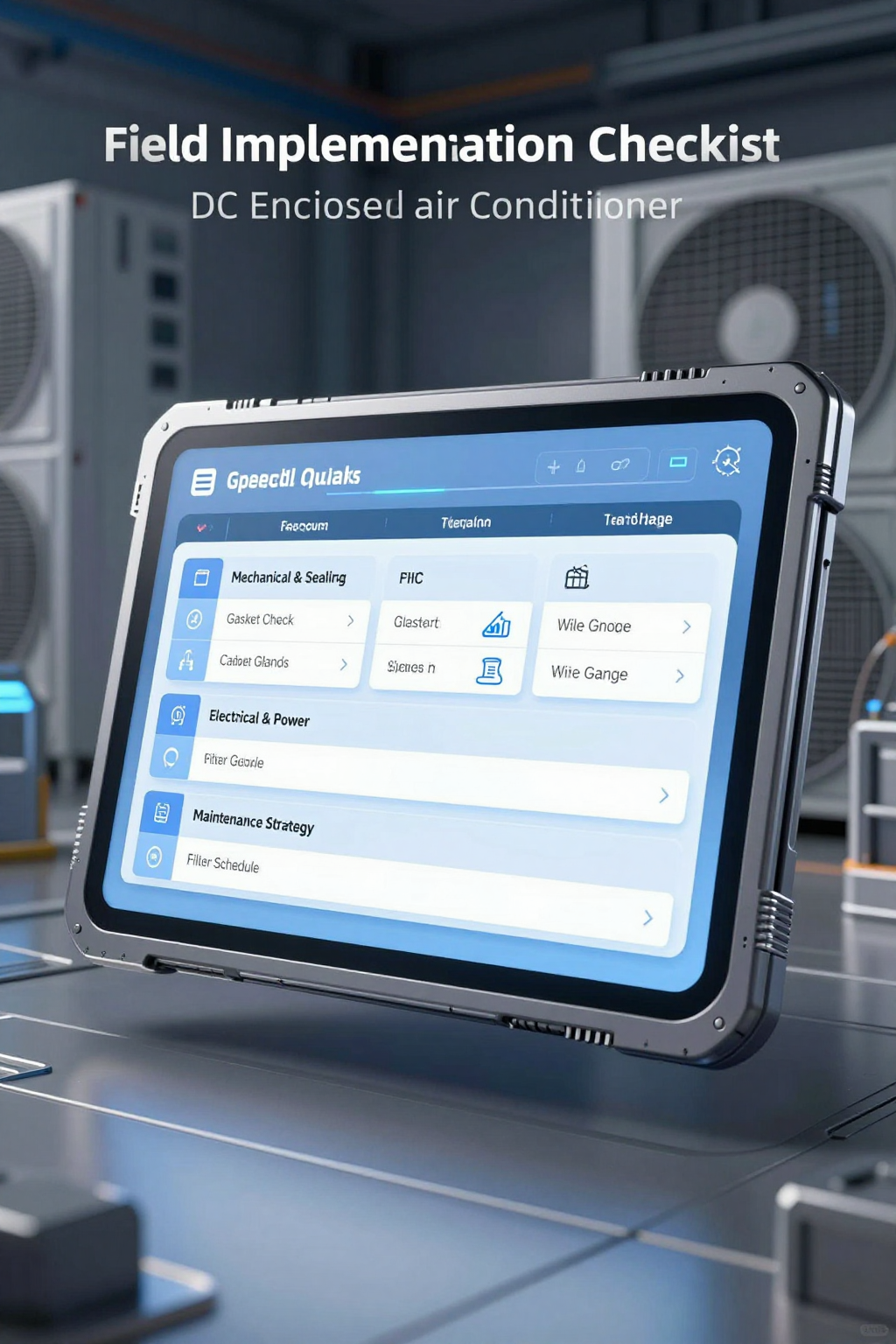
Field Implementation Checklist
Before commissioning a system, run through this checklist to ensure you aren’t building a “runs but hot” scenario.
Mechanical & Sealing
- Gasket Check: Is the mounting gasket continuous with no gaps?
- Cable Glands: Are all cable entries sealed? (Use expanding foam or rated glands, not just duct tape).
- Airflow Path: Is there at least 100mm of clearance in front of the intake and discharge vents?
- Solar Shielding: If outdoors, is a sunshade installed over the cabinet or the cooling unit?
Electrical & Power
- Wire Gauge: Is the supply wire sized for the maximum current (plus safety margin) to prevent voltage drop?
- Breaker Sizing: Is the fuse/breaker sized to handle potential inrush or startup transients?
- Voltage Stability: Does the power source remain within the operating range (e.g., 20V–30V for a 24V system) under load?
Maintenance Strategy
- Filter Schedule: In dusty environments, how often will the external condenser filter be cleaned? (Clogged filters = No cooling).
- Condensate Drain: Is the drain hose routed downwards with no kinks? Water backing up can damage electronics.
Expert Field FAQ
Q: My micro ac runs but cabinet still hot, is it broken?
A: Not necessarily. It is often undersized for the solar load or suffering from airflow short-circuiting. Check if the cold air is reaching the hot components.
Q: Can I run a 12V Micro DC Aircon directly off a vehicle battery?
A: Yes, but you typically need account for the alternator voltage spikes and engine-off battery drain. A low-voltage disconnect is recommended to save the battery.
Q: Why is ice forming on the evaporator coil?
A: This usually indicates low airflow across the evaporator (dirty filter or blocked vent) or operation in very low ambient temperatures without proper control logic.
Q: How much does a “sealed” enclosure actually leak?
A: It depends on the NEMA/IP rating. A NEMA 1 cabinet leaks significantly. A NEMA 4/IP65 cabinet should be airtight, but cable entries are the weak point. Even a small hole can introduce significant humidity.
Q: What is the advantage of a DC compressor over an AC unit with an inverter?
A: Efficiency and reliability. Using an inverter to convert battery DC to AC for a compressor introduces a 10-15% power loss and adds a point of failure. Native DC compressors are more efficient for battery/solar applications.
Q: Can I mount the unit horizontally?
A: This depends on the specific model and compressor oil management. Always check the installation manual. Most rotary compressors have strict orientation limits.
Conclusion: System Logic Over Component Swapping
When a micro ac runs but cabinet still hot, the instinct is often to blame the cooling unit. However, in our experience with hundreds of deployments, the unit is usually performing exactly as the laws of physics dictate given the constraints it is under. If you feed it hot air from a short-circuit, it will throttle down. If you starve it of voltage, it will slow down. If you leave the door unsealed, it will drown in humidity.
Successful thermal management in harsh environments is not just about buying a box with a high wattage rating. It is about ensuring the thermal loop—from the heat source, through the air, into the evaporator, and out to the ambient—is unbroken and unobstructed. By addressing airflow paths, sealing integrity, and power stability, you can turn a “running but hot” failure into a resilient, long-term solution.
Request Sizing Support
Don’t guess at the heat load. To ensure your next deployment stays cool, consult with our engineering team. Please have the following inputs ready for a defensible sizing calculation:
- Ambient Conditions: Max temperature and solar exposure (Direct/Shaded).
- Target Temperature: Maximum allowable internal temperature.
- Heat Load: Estimated dissipation of internal electronics (Watts).
- Power Source: Voltage (12/24/48V) and current limits.
- Sealing Target: IP or NEMA requirement.
- Dimensions: Cabinet size and available mounting space.
0 条评论