In the rapidly densifying world of Battery Energy Storage Systems (BESS), the margin for thermal error is vanishing. As cell densities increase and enclosures shrink, the thermal mass of a 48V battery cabinet becomes a double-edged sword: it provides temporary stability, but once heat accumulates, it becomes a runaway train. For OEM engineers and system integrators, the challenge is no longer just “keeping it cool.” It is about precise thermal management, preventing stratification, and mitigating the risk of thermal runaway before the Battery Management System (BMS) has to trigger a hard shutdown.
The shift toward decentralized, modular energy storage—often deployed in harsh, off-grid, or outdoor environments—demands a robust 48v battery cabinet cooling strategy that operates independently of the grid and aligns directly with the DC bus. Relying on passive ventilation or AC-powered cooling in a native DC environment introduces inefficiencies and reliability gaps that modern applications cannot afford. This article dissects the engineering realities of cooling sealed 48V battery cabinets, focusing on sensor placement, airflow architecture, and the selection of active cooling systems that prevent thermal runaway.
The Thermal Reality of 48V BESS Deployments
Battery cabinets are often marketed as “install and forget,” but the physics of lithium-ion chemistry (whether LFP or NMC) dictates otherwise. The optimal operating window is narrow—typically 15°C to 35°C. Exceeding 45°C significantly accelerates degradation, while approaching 60°C enters the danger zone for thermal runaway propagation. In outdoor deployments, solar loading alone can raise internal cabinet temperatures by 15°C to 20°C above ambient, even with zero load on the batteries.
For engineers designing systems for remote telecom towers, peak-shaving units, or mobile power trailers, the constraints are severe:
- Ambient Aggression: Deployments in deserts or tropical zones often face ambient temperatures (T_amb) exceeding 45°C, rendering passive cooling physically impossible (since T_amb > T_internal_target).
- Dust and Contaminants: Open-loop cooling (fans) introduces conductive dust, humidity, and salt fog, which can bridge BMS terminals or corrode busbars.
- Power Efficiency: In off-grid scenarios, every watt spent on cooling is a watt not available for the load. Inefficient cooling parasitically drains the very battery it protects.
Deployment Context: Two Common Scenarios
To ground our decision-making, let’s examine two typical engineering scenarios where standard cooling fails.
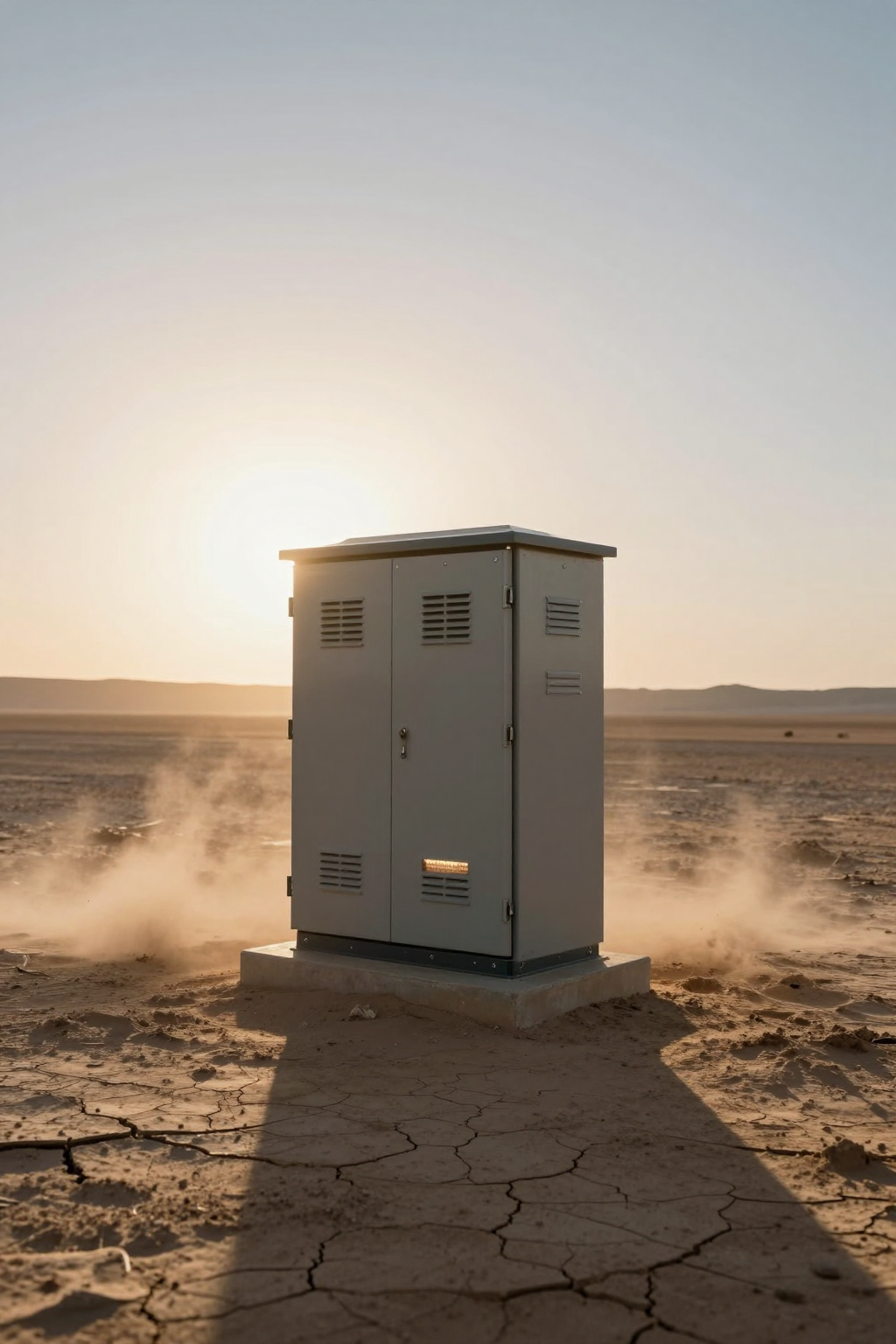
Scenario A: The Remote Telecom Node (Desert Environment)
Context: A 48V LiFePO4 battery bank supports a remote cellular tower. The site is off-grid, relying on solar + storage.
Constraints:
• Ambient Temperature: Peaks at 50°C during the day.
• Dust: High particulate matter (sand/dust storms).
• Maintenance: Site visits are costly (once every 6 months).
The Problem: Passive vents allow sand ingress, clogging filters within weeks. Once filters clog, airflow drops, and internal temperatures spike. Even with clean filters, 50°C ambient air cannot cool batteries to 35°C.
Requirement: A sealed enclosure (NEMA 4/4X or IP55) with active sub-ambient cooling.
Scenario B: Mobile Emergency Power Trailer
Context: A towable 48V BESS for disaster relief or construction sites.
Constraints:
• Vibration: Constant mechanical stress during transport.
• Power Source: Native 48V DC bus; no reliable AC shore power.
• Load Profile: High discharge rates (1C or higher) creating rapid internal heat generation.
The Problem: Using an AC air conditioner requires an inverter, adding conversion losses (10-15%) and a point of failure. Standard residential AC units cannot withstand road vibration.
Requirement: A vibration-resistant, DC-native cooling solution that runs directly off the battery bus.
Decision Matrix: Selecting the Right Thermal Strategy
When evaluating cooling technologies for a 48V cabinet, engineers must weigh cooling power against energy consumption and maintenance risks. The table below compares the three dominant approaches.
| Feature | Filtered Fans (Open Loop) | Thermoelectric (TEC/Peltier) | Micro DC Aircon (Compressor) |
|---|---|---|---|
| Sub-Ambient Cooling | Impossible (Always T_internal > T_ambient) | Yes (Limited Delta T) | Yes (High Delta T capability) |
| Sealed Enclosure (IP Rating) | No (IP54 max usually) | Yes (IP55/IP65) | Yes (IP55/IP65) |
| Cooling Capacity (Typical) | Dependent on airflow & Delta T | Low (50W – 200W) | Medium/High (300W – 3000W+) |
| Efficiency (COP) | High (but ineffective in heat) | Very Low (COP 0.5 – 0.8) | High (COP 2.0 – 3.5) |
| Maintenance Risk | High (Filter clogging) | Low (Solid state) | Low (Sealed system) |
| Best Fit Scenario | Indoor, climate-controlled rooms | Small enclosures, low heat load | Outdoor cabinets, high heat load, batteries |
Implication: For outdoor 48V battery cabinets where T_ambient can exceed 35°C, fans are disqualified by physics. TECs are generally too inefficient for large battery heat loads. Vapor-compression (Micro DC Aircon) is the only viable option for maintaining safe operating temperatures in harsh environments.
Quick Selection Rules for Design Reviews
- Rule 1: If T_ambient_max ≥ T_battery_limit, you must use active cooling (compressor or liquid). Fans cannot cool below ambient.
- Rule 2: If the environment contains conductive dust, salt, or high humidity, the enclosure must be sealed (closed-loop). Open-loop cooling is a reliability liability.
- Rule 3: If the power source is a 48V battery, use 48V DC native cooling. Avoiding an inverter improves system reliability and efficiency.
- Rule 4: If the heat load exceeds 300W, Thermoelectric (TEC) coolers will likely draw excessive current for the cooling provided. Switch to a compressor-based system.
- Rule 5: Always size cooling for the “worst-case stack”: Max Solar Load + Max Discharge Heat + Max Ambient Temperature.
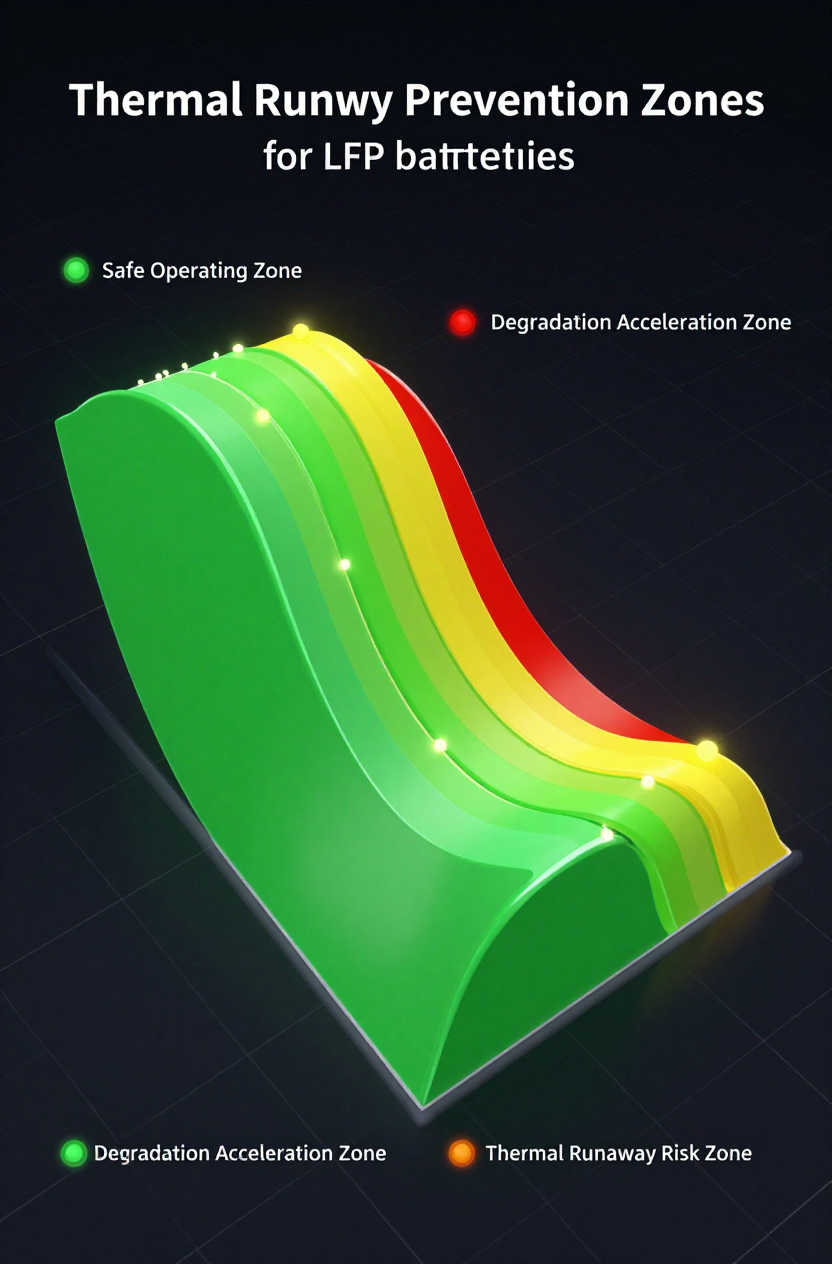
Failure Modes: The Unseen Enemies of Uptime
In our analysis of field failures, thermal issues in battery cabinets rarely stem from a total lack of cooling. Instead, they arise from specific integration oversights that allow heat to accumulate in pockets.
1. The Phantom Hotspot (Stratification)
Heat rises. In a tall battery cabinet, the top modules can be 5°C to 10°C hotter than the bottom modules if internal air circulation is poor. This differential causes the BMS to limit the charging/discharging rate of the entire bank based on the hottest cell, effectively derating the system capacity.
Mechanism: Lack of internal stirring fans or short-cycling of the cooling air (cold air goes straight back into the intake).
2. Sensor Blindness
Many integrators place the temperature sensor near the cooling air outlet. This gives a false “safe” reading while the core of the battery pack remains hot.
Risk: The cooling system cycles off prematurely, believing the job is done, while the thermal mass of the battery continues to radiate heat, potentially leading to thermal runaway triggers.
3. Filter Asphyxiation (Open Loop)
In fan-cooled systems, a partially clogged filter reduces CFM (cubic feet per minute) drastically.
Result: The heat removal rate drops below the heat generation rate. The temperature rises slowly but steadily until the high-temp cutoff trips. This often requires a truck roll to simply swap a filter—a massive OpEx drain.
Engineering Fundamentals: Why DC Vapor Compression Works
To understand why a Micro DC Aircon is the standard for robust BESS protection, we must look at the thermodynamics. Batteries have high thermal mass; they heat up slowly but also cool down slowly. A cooling system must have the capacity to “pull” heat out faster than it is generated during peak discharge.
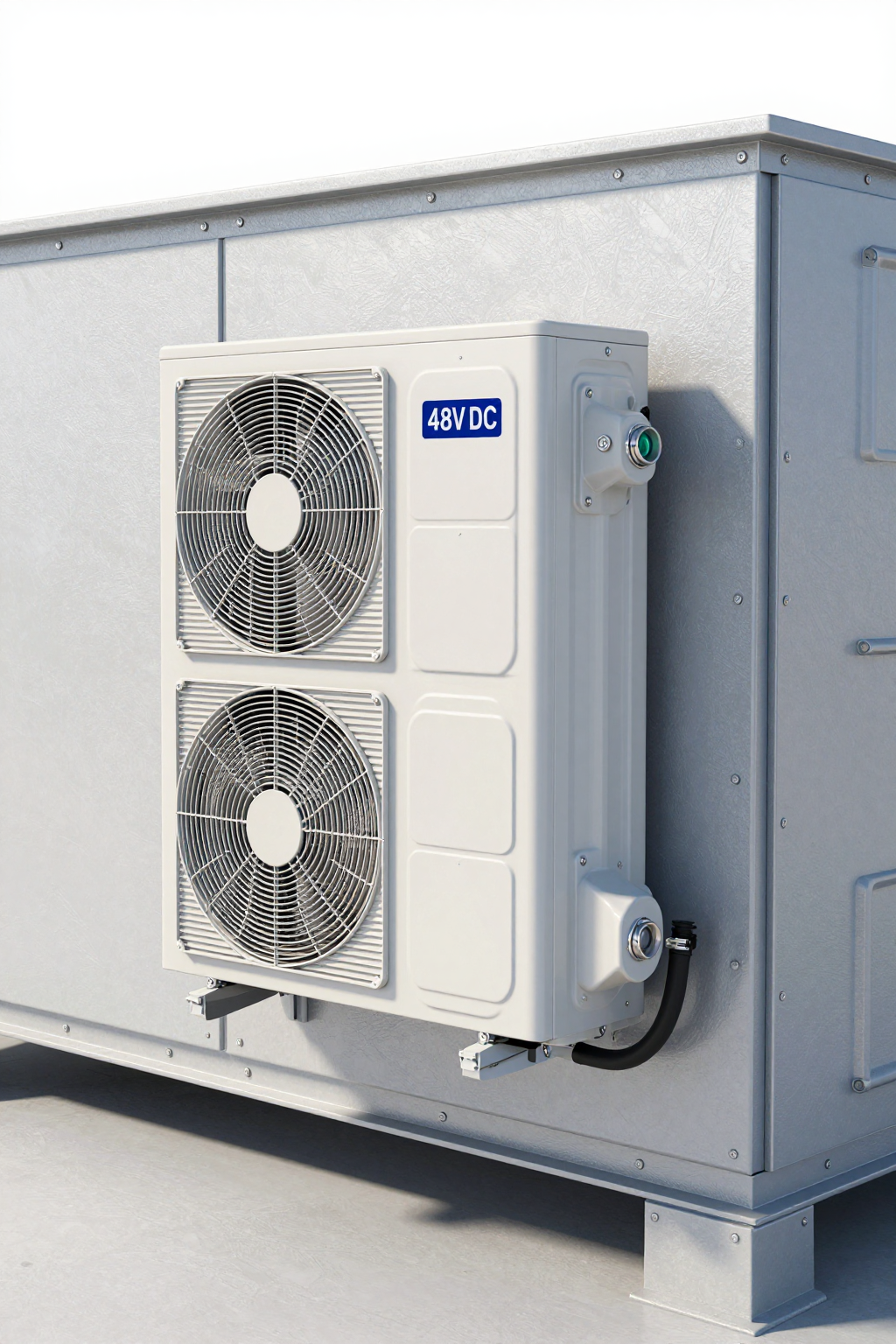
The Phase Change Advantage: Vapor compression systems use the phase change of a refrigerant (like R134a) to absorb heat. This process is significantly more energy-dense than simply moving air (fans) or using the Peltier effect (TEC). A micro compressor can absorb 450W of heat while consuming only ~150W of electrical power. This Coefficient of Performance (COP) of ~3.0 is critical for battery-powered systems.
Direct DC Drive: Traditional air conditioners use AC induction motors, requiring an inverter when running off batteries. This inverter introduces efficiency loss (typically 10-15%) and harmonic noise. A 48V DC air conditioner uses a BLDC (Brushless DC) motor for both the compressor and the fans. It connects directly to the battery bus. This eliminates the inverter point-of-failure and allows for variable speed control. The system can ramp down to a low-power “eco mode” when the heat load is low, rather than cycling on/off, which stabilizes the battery temperature more effectively.
Performance Data & Verified Specs
When selecting a cooling unit, vague marketing terms like “high capacity” are dangerous. Engineers need specific data points: Cooling Capacity (L35/L35), Power Consumption, and Refrigerant type. Below are the verified specifications for the Arctic-tek DV series, specifically designed for 48V applications.
| Parameter | DV1930E-AC (Pro) | DV3220E-AC (Pro) |
|---|---|---|
| Voltage | 48V DC | 24V DC (Requires DC-DC for 48V bus) |
| Nominal Cooling Capacity | 450W (1,535 BTU/h) | 550W (1,876 BTU/h) |
| Refrigerant | R134a | R134a |
| Compressor Type | Miniature BLDC Rotary | Miniature BLDC Rotary |
| Control | Integrated Driver Board (Inverter) | Integrated Driver Board (Inverter) |
| Application | Native 48V Battery Cabinets | High-Density Compact Cooling |
Note: Cooling capacity varies based on ambient temperature and internal setpoint. The values above are typical at standard test conditions.
For applications requiring extremely compact integration, the Miniature DC Compressor series (e.g., QX1903VDL for 48V) allows engineers to build custom cooling loops directly into the battery pack structure, effectively turning the battery module into a chilled plate system.
Field Implementation Checklist: Layout & Sensors
A high-quality cooling unit can fail if integrated poorly. Use this checklist to ensure your 48v battery cabinet cooling design is resilient.
1. Airflow Management
- Create a Cold Aisle/Hot Aisle: Even in a small cabinet, direct the cold air from the AC unit to the bottom or front of the battery stack, and pull the return air from the top or rear.
- Prevent Short-Cycling: Install baffles to ensure the cold air cannot immediately be sucked back into the AC intake. The air must pass through or over the battery modules.
- Clearance: Ensure at least 100mm of clearance around the AC unit’s external condenser intake/exhaust to prevent hot air recirculation outside the cabinet.
2. Sensor Placement Strategy
- Control Sensor (Return Air): Place the AC unit’s control thermistor in the return air path (warmest air entering the cooler). This ensures the unit works until the entire volume is cooled.
- Safety Sensor (Cell Casing): The BMS temperature probes should be mounted directly on the battery cells, ideally in the center of the stack (the thermal hotspot).
- Discrepancy Alarm: Program the controller to alarm if the Delta T between the air temp and the cell temp exceeds a set threshold (e.g., 10°C), indicating airflow blockage.
3. Electrical & Sealing
- Cable Glands: Use IP68 rated cable glands for all penetrations. A single unsealed cable hole can suck in dust and moisture, compromising the IP rating.
- Fuse Protection: Install a dedicated DC breaker or fuse for the cooling unit, sized for the inrush current (though BLDC soft-start minimizes this).
- Condensate Drain: Active cooling removes humidity. Ensure the condensate drain tube is routed outside the cabinet and has a trap or valve to prevent insect ingress.
Expert Field FAQ
Q: Can I use a 24V cooler on a 48V battery system?
A: Technically yes, but you would need a DC-DC converter (48V to 24V). This adds cost, weight, and an efficiency loss (typically 5-10%). It is far better engineering practice to use a native 48V unit like the DV1930E-AC to connect directly to the bus.
Q: How does 48v battery cabinet cooling impact the autonomy of the system?
A: An active cooler is a parasitic load. However, a Micro DC Aircon is highly efficient. For a 450W cooling load, it might draw ~150W. If your battery is 10kWh, running the cooler for 5 hours consumes ~0.75kWh, or 7.5% of capacity. This is a necessary investment to prevent the battery from degrading or shutting down due to heat.
Q: What is the best setpoint temperature?
A: We typically recommend a setpoint of 25°C to 28°C. Cooling below 20°C wastes energy and increases the risk of condensation on the battery terminals if the cabinet is opened. The goal is to keep the battery below 35°C, not to make it “cold.”
Q: How do I handle condensation?
A: Vapor compression naturally dehumidifies the air. You must route the condensate drain tube out of the cabinet. Ensure the tube is not kinked and has a “gooseneck” or trap to prevent outside air/dust from entering through the tube.
Q: My cabinet is IP55. Do I need a filter on the external side of the AC?
A: The external loop of the AC unit (condenser side) is exposed to ambient air. While the internal loop is sealed, the external fins can get clogged. If you are in a high-dust environment, an external mesh filter is recommended, or choose a unit with wide-fin spacing designed for “filterless” operation in dusty zones.
Q: What happens if the cooling unit fails?
A: The BMS should have a high-temperature disconnect. To prevent sudden shutdowns, use the “Discrepancy Alarm” strategy mentioned above to detect cooling degradation early (e.g., rising temps despite cooling being “on”) and dispatch maintenance before a critical thermal runaway risk occurs.
Conclusion & System Logic
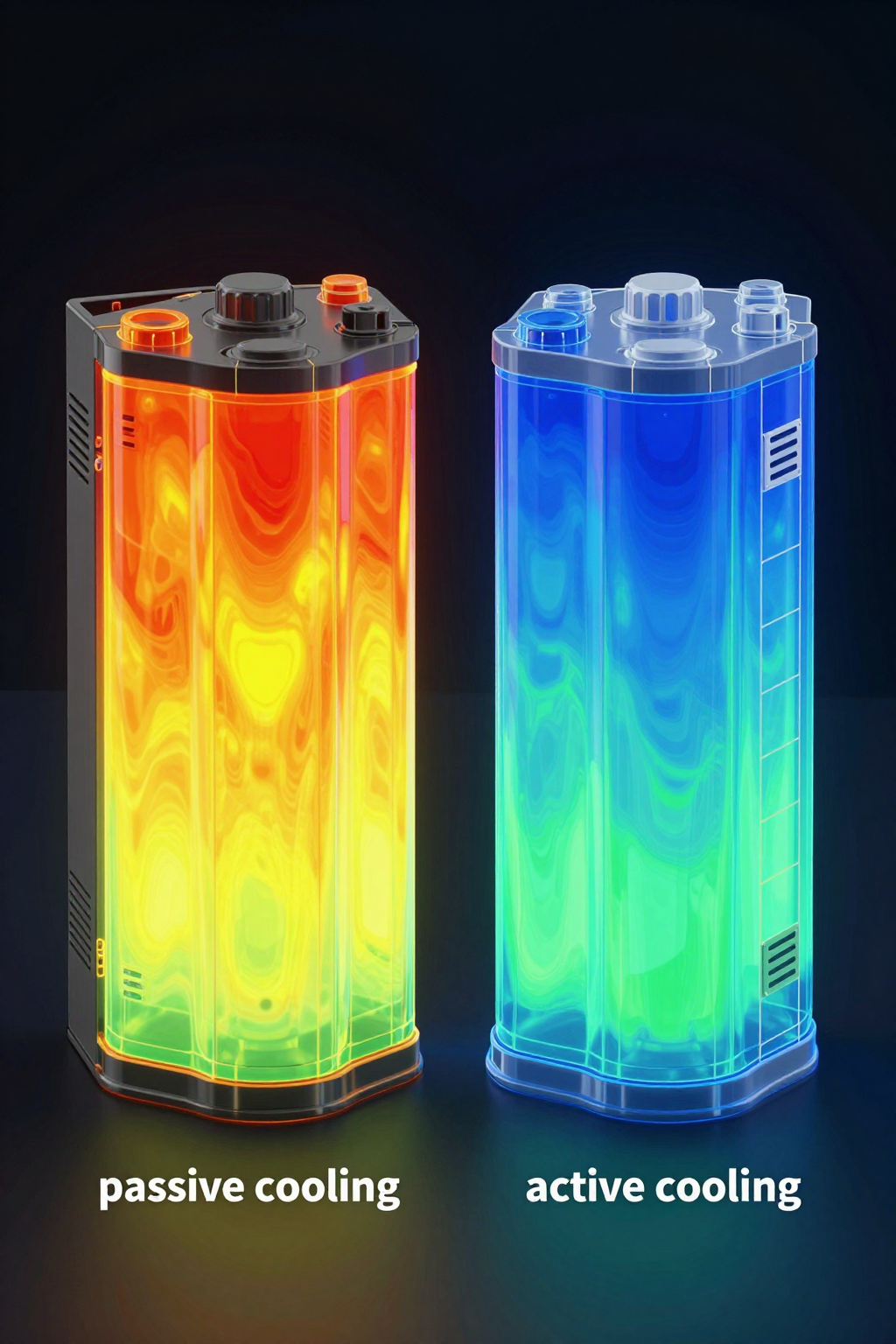
The safety and longevity of a BESS depend as much on the thermal management system as they do on the cell chemistry. For 48V systems deployed in harsh or remote environments, passive methods are often a gamble that engineers cannot afford to take. The physics of heat transfer in dense enclosures simply demands active intervention when ambient temperatures rise.
By selecting a native DC condensing unit or Micro DC Aircon, engineers can ensure a closed-loop, efficient, and reliable cooling path that integrates seamlessly with the 48V bus. The key to success lies not just in buying the hardware, but in the layout: ensuring airflow actually reaches the cells, placing sensors where they tell the truth, and sealing the enclosure against the elements. A robust 48v battery cabinet cooling strategy is the insurance policy that keeps your energy storage system online, safe, and profitable.
Request a Sizing Consultation
Don’t guess on thermal loads. To get a precise sizing recommendation for your specific cabinet, please prepare the following inputs and contact our engineering team:
- Target Internal Temperature: (e.g., 25°C)
- Max Ambient Temperature: (e.g., 50°C)
- Heat Load Estimate: (Watts generated by batteries + electronics)
- Cabinet Dimensions & Insulation: (H x W x D, wall thickness)
- Power Source: (Voltage range, e.g., 42V – 56V DC)
- Environmental Constraints: (Dust, Salt, Vibration, IP rating)
0 条评论